

Bottle with an attached cap: how intellectual property works and what is protected

Content of the article
Content of the article
The bottle with an attached cap has become the subject of many discussions and memes. Let’s take a look at how intellectual property works for such a bottle and what patents protect what aspects.
A bit of background
The development of the bottle with an attached cap is a deliberate tool in the fight for environmental protection. European Union countries are actively implementing measures to protect the environment and combat the excessive spread of plastic. It is known that different types of plastic decompose over different periods of time. For example, thin single-use polyethylene bags take 10-20 years to decompose, while plastic bottles (PET) take 450 years or more. Therefore, as of July 1, 2024, the EU Directive No. 2019/904 came into effect, requiring all bottles to be made with attached caps. So, what and how is being protected?
Patenting
An object, such as a bottle with an attached cap, can be protected as an invention if it is new, can be practically used in a particular industry, and the solution is not obvious to a specialist in the relevant technical field. In some countries, the object may be protected as a utility model (also known as a “small patent”) if it is new and industrially applicable.
Several similar invention applications have already been filed in various countries. For example, the Swiss company Obrist Closures Switzerland GmbH, which specializes in the production of plastic packaging, registered this invention (Patent No. 11,717,470) in 38 European countries in 2023. The object is called the “Flip-top dispensing closure.” According to the patent description, when opening the container (bottle), only the top part of the cap is removed, while the bottom locking ring remains securely attached to the container (bottle) opening. A strip connects the locking ring to the lid wall, ensuring that the cap remains attached to the container (bottle) and cannot be discarded or thrown away separately.
The Finnish company Esbottle Oy, which develops packaging solutions, filed an application (No. EP3889062) for a similar invention in March 2021. The object is called the “Tethered one-piece closure.” The need for patenting such a technical solution is explained by the fact that in some countries, bottle caps are usually not collected or returned for recycling. They are often disposed of in landfills or end up in water bodies or oceans, where fish or other animals may mistake them for food, leading to injury or death. Additionally, recycling programs in some countries encourage the public to detach caps from bottles to compact them during collection and transportation in the recycling process, as a sealed empty bottle is harder to compress than an unsealed one.
In conclusion, “technology,” in the broad sense, can be protected by a patent. It is recommended, in addition to well-prepared patent documentation (claims, description, drawings, etc.), to perform a novelty check for the solution. In other words, it does not always make sense to invest time and resources in patenting if the technology is already well known, patented, or not unique.
Design registration
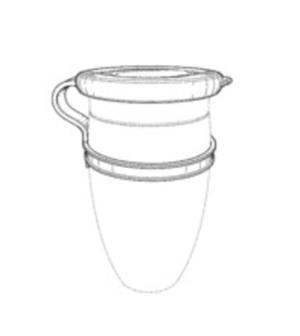
The appearance of the attached cap can also be protected as an industrial design. This protection is subject to requirements, including novelty and individuality. For example, designer Albert Van from the USA registered the design of the attached cap for a cup in February 2019 (international registration number D839730). Notably, the cup itself is not part of the protected object. The image of the cup was added to the application to visually demonstrate the use of the attached cap.
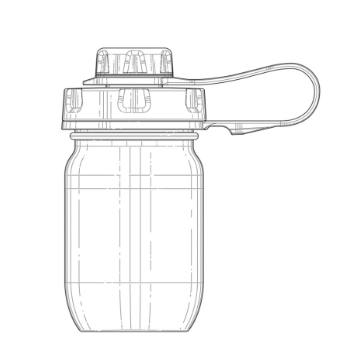
A similar object was registered in Japan in June 2017 by the American company Humangear INC., which specializes in innovative, reusable, and eco-friendly products designed for travel and everyday use (registration number D1580123). The design is called “Jar having cap-on-cap container lid.” The unique feature of this cap is that the design includes a strap connecting the upper cap to the lower cap, allowing the position of the upper cap relative to the lower cap to change within the limits of the strap.
Although design registration often goes through a formal procedure (under the applicant’s responsibility and without substantive examination), it is better to consciously check the uniqueness of such a solution. This will allow you to assess your chances in advance if someone tries to have the patent declared invalid. On the other hand, a patent that meets all the registration requirements can protect your developments from being copied by others and provide the opportunity to prohibit others from using your unique design.
Trademark registration
Three-dimensional objects can also be protected by a trademark. For example, the Italian company Ferrero S.P.A. has registered a significant number of three-dimensional trademarks in the form of various types of bottles in many countries around the world.
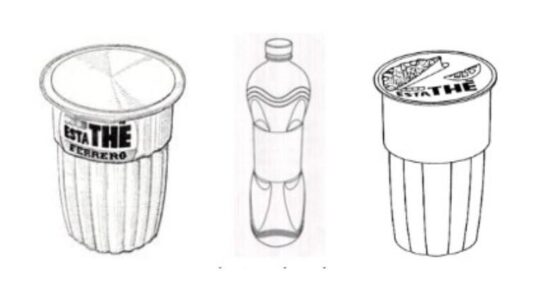
The complexity of registering such trademarks lies in the fact that elements of the design that have only a functional purpose cannot be protected as trademarks. For example, under EU legislation, all beverage bottles up to 3 liters in size must have an attached cap, which is a standard market solution that does not fulfill the primary purpose of a trademark — distinguishing goods and services between different entrepreneurs. As a result, for a bottle to be registered as a trademark, it must have a unique shape and design, meaning it must significantly differ from existing bottle designs.
In addition to the appearance, which will be protected, the scope of protection must be chosen. In general, the fields of activity for trademark registration are divided into 45 classes, 34 of which are for goods and 10 for services. For a bottle, it is advisable to choose:
- Class 21 for goods, which includes bottles;
- Class 35 for services, which includes the display and sale of goods.
As additional classes, you may choose:
- Class 32 for goods — non-alcoholic beverages;
- Class 33 for goods — alcoholic beverages;
- Class 39 for services — bottling;
- Class 43 for services — catering services related to the provision of beverages.
Copyright registration
Patents are the industrial part of intellectual property. There are also copyrights and related rights. In general, the list of objects that can be protected by copyright is not exhaustive and can certainly include graphic images, drawings, unique color solutions, descriptive texts on packaging if they are the result of creativity, audiovisual works such as an advertisement video where the bottle is the main object, etc.
Copyright itself arises in most countries at the moment of creation of the object. Registration is not mandatory in most countries, but it is useful for additional documentation of the author’s rights to the object, especially if there is a legal dispute regarding the work. Copyright registration in the United States grants more rights to the author, such as the right to file a lawsuit to stop infringement and the right to claim compensation for rights violations.
In addition to copyright registration, it is also possible to enter into and register a contract for the transfer of exclusive property rights from the author to another person. This is necessary when the work was created on commission or during the performance of work duties by an employee. However, the author retains personal non-property rights—such as the right to give the work a title, dedicate it to a specific person or date, and the right to prohibit the mention of their name, among others.
Conclusion
The bottle with an attached cap is an innovative solution aimed at environmental protection. There are a large number of intellectual property objects, such as patents, trademarks, copyrights, and industrial designs. The bottle with a cap can be protected by a patent and design (industrial design). Additionally, it is possible to register the object as a trademark or copyright, although these are less common methods of protection due to the specific requirements for such intellectual property objects. Each type of protection should be used to ensure legal protection for your solution.
Published by CASES
Share


FAQ
Why are bottles with attached caps becoming common?
Can a bottle with an attached cap be patented?
What part of the bottle can be patented?
Can the design of the cap be protected?
Can a bottle shape be registered as a trademark?
Can copyright apply to packaging?
Can several IP rights protect the same product?
Why is choosing the right IP protection strategy important?
Why are bottles with attached caps becoming common?
Attached bottle caps are part of environmental initiatives in the European Union aimed at reducing plastic waste and improving recycling systems.
Can a bottle with an attached cap be patented?
Yes. The technical mechanism of the cap can be protected by a patent if it meets the requirements of novelty, industrial applicability and inventive step.
What part of the bottle can be patented?
Patents may protect the technical structure of the cap, such as the mechanism that keeps the cap attached to the bottle while allowing it to open and close.
Can the design of the cap be protected?
Yes. The appearance of the bottle or cap may be protected as an industrial design if it has a unique shape or aesthetic features.
Can a bottle shape be registered as a trademark?
In some cases, the shape of a bottle may be registered as a three-dimensional trademark if it is distinctive and allows consumers to identify the brand.
Can copyright apply to packaging?
Yes. Copyright may protect creative elements such as graphic design, illustrations and advertising materials used in product packaging.
Can several IP rights protect the same product?
Yes. A product may be protected simultaneously by patents, industrial designs, trademarks and copyright, depending on which elements require protection.
Why is choosing the right IP protection strategy important?
Combining different forms of intellectual property protection allows businesses to protect both the technology and the visual identity of their products from competitors.








We use cookies to improve the performance of the site and enhance your user experience.
More information can be found in our Privacy Notice