

International powers of attorney and authorization certification

Content of the article
- Preparing a power of attorney abroad for use in Ukraine
- Preparing a power of attorney in Ukraine for use abroad
- Comparison of certification methods: which option to choose
- Common mistakes when preparing international powers of attorney
- Certification of supporting documents and corporate authority
- Conclusions and practical recommendations for 2026
Content of the article
- Preparing a power of attorney abroad for use in Ukraine
- Preparing a power of attorney in Ukraine for use abroad
- Comparison of certification methods: which option to choose
- Common mistakes when preparing international powers of attorney
- Certification of supporting documents and corporate authority
- Conclusions and practical recommendations for 2026
According to Eurostat, more than 4.3 million Ukrainians live and work abroad, primarily in European countries. Many of them still have unresolved matters in Ukraine, such as selling real estate, being represented in court, or managing a business. At the same time, people residing in Ukraine increasingly need a power of attorney to open a bank account, relocate, or conduct business abroad. In both situations, the key question is the same: will the document be recognized in the country where it is intended to be used, and what steps are necessary to ensure its legal validity and avoid rejection?
Preparing a power of attorney abroad for use in Ukraine
If you are abroad and need a power of attorney to authorize someone to act on your behalf in Ukraine, the first practical step is to agree on the wording of the document with a Ukrainian notary or lawyer in advance. This is important because language that is acceptable in another jurisdiction may not meet the formal requirements of Ukrainian law.
There are two ways to certify a power of attorney abroad: through a local notary or through a Ukrainian consular office. Each option has its own procedure, advantages, and limitations.
Option A: Local notary
Step 1. Notarization of the power of attorney
The principal provides their passport details, a draft of the power of attorney, and pays the applicable notarial fees. The document is usually prepared in the official language of the country where it is executed. A bilingual power of attorney is often the best solution, as it includes both the local language and Ukrainian, eliminating the need for a separate translation during the legalization process.
Step 2. Apostille or consular legalization
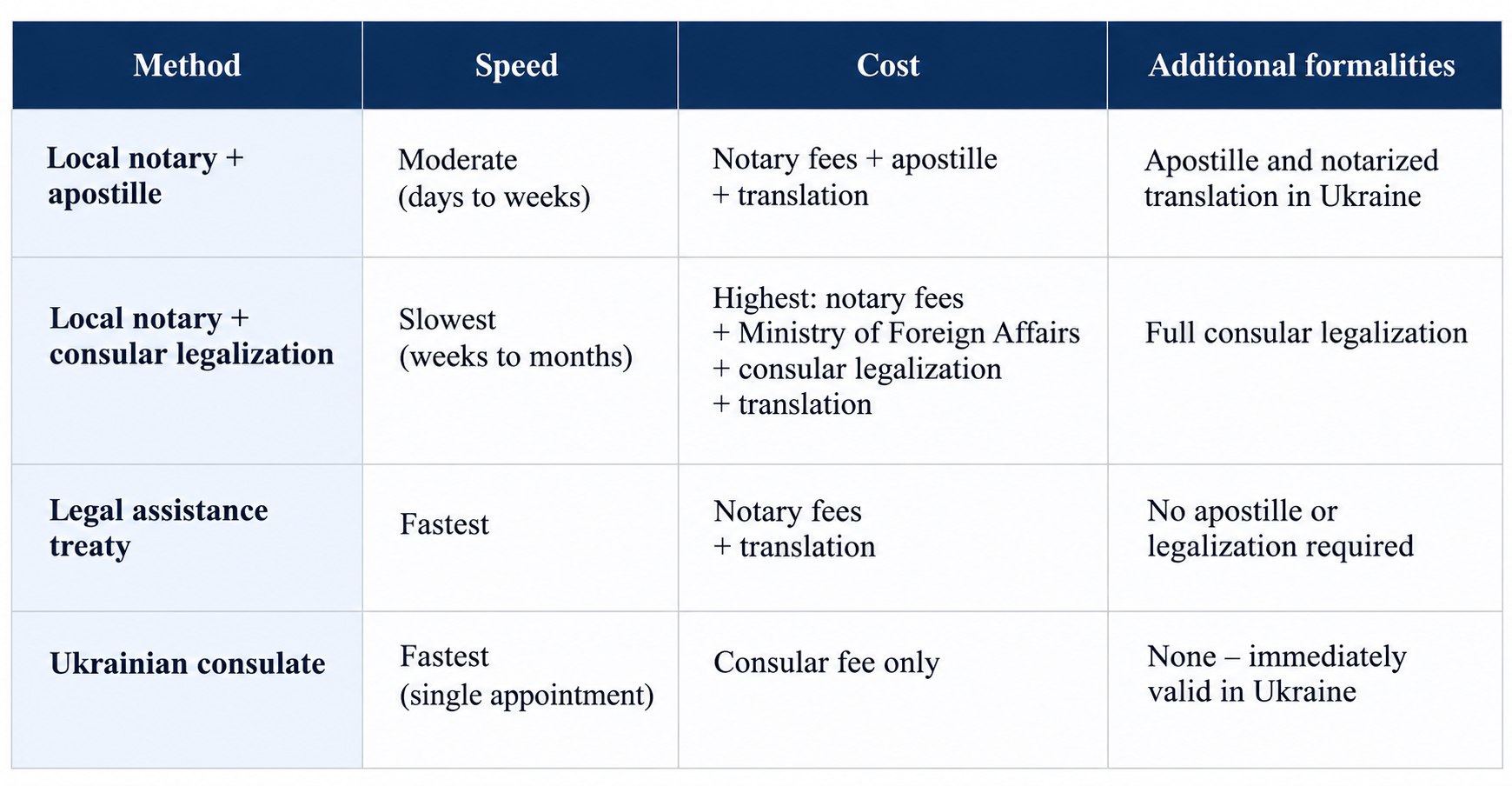
For the power of attorney to be legally valid in Ukraine, it must either receive an apostille (a simplified authentication procedure) or undergo full consular legalization, depending on whether the country where it was issued is a party to the 1961 Hague Convention.
Apostille. The 1961 Hague Convention abolished the requirement for full legalization of official documents between member states. A document only needs an apostille certificate, which is recognized by all Convention members without further authentication. Most EU countries, as well as the United Kingdom, the United States, and Canada, are parties to the Convention. In these jurisdictions, apostilles are generally issued by the Ministry of Justice or another designated competent authority.
Consular legalization. If the document is issued in a country that does not recognize apostilles, such as China, the United Arab Emirates, or Saudi Arabia, it must undergo full consular legalization. After notarization and translation, the document is first authenticated by the foreign ministry of the issuing country and then legalized by the Ukrainian consulate in that country. This procedure is generally more time-consuming and costly.
Step 3. Notarized Ukrainian translation
Once the document is brought to Ukraine, the final mandatory step is obtaining a notarized Ukrainian translation. Without it, Ukrainian authorities and notaries will not accept the power of attorney.
Simplified procedure under legal assistance treaties
Ukraine has concluded bilateral legal assistance treaties with several countries that allow official documents to be recognized without an apostille or consular legalization. In these cases, only a notarized Ukrainian translation is required. Such countries include Poland, Lithuania, Latvia, Estonia, the Czech Republic, and several CIS countries, including Azerbaijan, Armenia, Kazakhstan, and Moldova.
This significantly simplifies and reduces the cost of the process. A power of attorney executed in one of these countries can generally be used in Ukraine for real estate transactions, court representation, or signing commercial agreements without obtaining an apostille.
Option B: Ukrainian consulate
An alternative to visiting a local notary is to execute the power of attorney directly at a Ukrainian consular office. This option offers a significant practical advantage: the document is immediately valid in Ukraine without the need for an apostille, legalization, or translation.
Step-by-step procedure for visiting a Ukrainian consulate
Verify the consulate’s authority. Before making an appointment, confirm that the specific Ukrainian consular office is authorized to perform notarial acts, as not all consulates provide these services.
Book an appointment. Appointments are usually scheduled online through the website of the relevant Ukrainian embassy or consulate.
Prepare the draft power of attorney. It is recommended to send the draft document in Microsoft Word format to the consulate three to four business days before your appointment. If no draft is submitted, the consulate will typically use its standard template, which may not reflect your specific needs.
Notarization. On the day of your appointment, you should bring your passport, a copy of your Ukrainian tax identification number (TIN), and any documents relevant to the subject matter of the power of attorney. The document is usually prepared and issued on the same day.
No additional formalities. No apostille, legalization, or translation is required. The power of attorney is immediately valid for use in Ukraine.
This option is often the fastest and most cost-effective, particularly when time is critical, for example, in urgent real estate transactions or court proceedings with strict procedural deadlines.
Preparing a power of attorney in Ukraine for use abroad
The reverse situation is also common: a person is in Ukraine but needs a power of attorney for use abroad, for example, to establish a company, open a bank account, or represent their interests in foreign court proceedings. In this case, there are also two possible approaches.
Step 1. Drafting the power of attorney
The document must comply not only with Ukrainian law but also with the legal requirements of the country where it will be used. This is a crucial point. A power of attorney prepared solely in accordance with Ukrainian standards may be rejected by a foreign authority if it does not meet the required format or scope of authority recognized in that jurisdiction. Before visiting a notary, it is advisable to consult legal professionals familiar with the requirements of the destination country.
Step 2. Notarization of the power of attorney
The required documents typically include your passport, Ukrainian tax identification number (TIN), and the draft power of attorney. The document can be certified in one of the following ways:
Ukrainian notary. This is the standard option for most powers of attorney, particularly those involving real estate, corporate rights, or motor vehicles. In such cases, a notarized instrument is mandatory.
Consulate of the destination country in Ukraine. A consular officer may certify the authenticity of a signature on a privately prepared power of attorney. However, this option does not apply to powers of attorney relating to the disposal of real estate, management of corporate rights, or transactions involving motor vehicles. Such matters require a notarized instrument and cannot be completed solely through consular signature certification.
Step 3. Apostille or consular legalization
After the power of attorney has been notarized, the principal must apply to the Ministry of Justice of Ukraine for an apostille if the destination country is a party to the 1961 Hague Convention. The apostille is issued upon submission of the required application and payment of the applicable fee.
If the destination country does not recognize apostilles, the document must undergo full consular legalization through the Ministry of Foreign Affairs of Ukraine and the consulate of the destination country.
Comparison of certification methods: which option to choose
Common mistakes when preparing international powers of attorney
Based on our experience, most refusals to recognize a power of attorney are caused not by the absence of an apostille or consular legalization, but by errors in the document’s content or form. The most common mistakes include:
- Failure to meet formal requirements, such as missing mandatory details, incomplete information about the parties, an insufficiently precise description of the granted powers, or the absence of a validity period.
- Non-compliance with notarization requirements. A notarized instrument is the internationally accepted standard that provides the highest level of legal certainty and recognition across jurisdictions. Deviating from this standard may significantly reduce the likelihood that the document will be accepted.
- Incomplete translation of the document. If the translator’s full name and professional qualifications are not indicated, the translation may be considered legally invalid for official purposes.
- Failure to notarize the translation. This is one of the most common reasons why authorities and notaries refuse to accept a power of attorney.
- Failure to specify the validity period. A power of attorney without a clearly defined duration of authority creates legal uncertainty and may be challenged.
- Vague or overly broad wording of the granted powers. For example, authorizing someone simply to “represent the principal in court” without identifying specific proceedings or categories of cases may result in disputes over the representative’s authority.
- Appointing multiple attorneys-in-fact without defining how they may exercise their authority. If the document names several representatives but does not specify whether they may act independently, jointly, or by majority decision, this may complicate implementation and give rise to legal disputes.
Certification of supporting documents and corporate authority
In addition to the power of attorney itself, many situations require the preparation of supporting documents, such as copies of a passport, a tax identification number (TIN), or the company’s corporate and constitutional documents. These documents must also be notarized before they can be used for official purposes.
Confirmation of corporate authority
To complete registration procedures in Ukraine or abroad, it is necessary to formally confirm the authority of the individual acting on behalf of a legal entity. The key documents establishing such authority include:
- The company’s Articles of Association, including an official record of the latest amendments, confirming the company’s governance structure and any limitations on the directors’ authority.
- An extract from the Unified State Register (USR), confirming the current information about the company’s director, shareholders or participants, and legal status.
These documents determine who is authorized to sign powers of attorney on behalf of the company, adopt resolutions at shareholders’ or participants’ meetings, and appoint the company’s director. Without notarized copies of the Articles of Association and the USR extract, a foreign authority or bank may refuse to recognize the authority of the person signing documents on behalf of the company.
Certification procedure
The Articles of Association and the USR extract may be certified by a notary in Ukraine or by a Ukrainian consular office abroad. After certification, the documents must either receive an apostille from the Ministry of Justice of Ukraine (for countries that are parties to the 1961 Hague Convention) or undergo full consular legalization (for all other jurisdictions), following the same procedure applicable to personal powers of attorney.
Conclusions and practical recommendations for 2026
Practical recommendations
- Always ensure that the power of attorney clearly confirms that the authority of the appointed representative(s) has been verified and notarized.
- Limit the number of representatives to no more than three. Although Ukrainian law does not impose a strict limit, appointing a larger number of representatives without clearly defining how they should act increases the risk of delays and disputes regarding the exercise of their authority.
- Whenever possible, choose a Ukrainian consulate instead of a local notary, provided your matter does not fall within one of the exceptions, such as real estate, corporate rights, or motor vehicles. The consular route can significantly reduce both the time and cost involved.
- Check in advance whether the relevant country has a bilateral legal assistance treaty with Ukraine. If such a treaty exists, an apostille or consular legalization may not be required.
- Prepare a bilingual power of attorney from the outset if you intend to use the document both in Ukraine and abroad. This helps minimize translation errors and avoids unnecessary administrative formalities.
Actions that cannot be delegated under a power of attorney
Under the Civil Code of Ukraine and the general principles of private international law, including the 1961 Hague Convention, certain legal acts require the personal participation of the principal and cannot be delegated to a representative under a power of attorney. These include:
- Entering into or dissolving a marriage, establishing guardianship, or completing an adoption.
- Executing, amending, or revoking a will.
- Changing a person’s first name, surname, or patronymic, as well as acquiring or renouncing citizenship.
- Voting in elections or referendums, or participating in shareholders’ or participants’ meetings where the company’s constitutional documents expressly require personal attendance.
Understanding these limitations is essential when planning the appropriate legal mechanism. If your intended action falls within one of these exceptions, you should consider an alternative legal solution, such as personal attendance, remote participation where permitted, or another legally recognized procedure, rather than relying on representation through a power of attorney.
Share


FAQ
Is a Ukrainian power of attorney automatically recognized abroad?
How long does it take to obtain an apostille in Ukraine?
Can a power of attorney be issued remotely without appearing before a notary or consular officer?
What should I do if I need a power of attorney urgently but the apostille process takes weeks?
Can I appoint several representatives under one power of attorney?
Is a translation required if the power of attorney is prepared in two languages?
Can a power of attorney issued abroad be revoked?
Is a power of attorney issued by a Ukrainian consulate valid in a third country without an apostille?
Which option is better for purchasing real estate in Ukraine while living abroad: a local notary or a Ukrainian consulate?
What is the recommended validity period for a power of attorney?
Is a Ukrainian power of attorney automatically recognized abroad?
No. A Ukrainian power of attorney is not automatically recognized in any jurisdiction. Depending on the destination country, the document may require an apostille (for countries that are parties to the 1961 Hague Convention), full consular legalization (for other jurisdictions), or, where a bilateral legal assistance treaty exists between Ukraine and the relevant country, only a notarized translation without additional authentication. Verifying the legal requirements of the destination country should always be the first step before preparing the document.
How long does it take to obtain an apostille in Ukraine?
Under the standard procedure, the Ministry of Justice of Ukraine usually issues an apostille within several business days, although processing times may vary depending on the regional authority and current workload. Some offices also offer expedited processing for an additional fee. We recommend checking the current processing times directly with the competent authority, as they may change.
Can a power of attorney be issued remotely without appearing before a notary or consular officer?
In most cases, no. The personal presence of the principal remains a mandatory requirement for notarizing a power of attorney or certifying a signature before a consular officer. This is a fundamental principle of notarial practice intended to verify the identity of the principal and ensure that the document is signed voluntarily. While certain jurisdictions may provide limited exceptions for specific types of documents, personal attendance is generally required for powers of attorney relating to real estate, court representation, or corporate matters.
What should I do if I need a power of attorney urgently but the apostille process takes weeks?
The fastest lawful solution is usually to execute the power of attorney directly at a Ukrainian consulate if you are abroad, or at the relevant foreign consulate if you are in Ukraine. In many cases, documents issued through a consular office do not require a separate apostille or legalization and become effective immediately after issuance. If the transaction requires a notarized instrument, such as those involving real estate, corporate rights, or motor vehicles, the consular option may be limited, and you should check whether expedited apostille services are available.
Can I appoint several representatives under one power of attorney?
Yes. Ukrainian law does not impose a strict limit on the number of representatives. However, as a practical matter, it is advisable to appoint no more than three representatives. If multiple representatives are appointed, the document should clearly specify whether they may act independently, jointly, or by majority decision. Failure to define this mechanism may lead to delays, disputes, or even refusal by third parties to recognize their authority.
Is a translation required if the power of attorney is prepared in two languages?
Not necessarily. If the document is drafted as a bilingual power of attorney, for example in Ukrainian and English with identical text in both languages, a separate translation is generally not required for apostille or legalization purposes. This is one of the main reasons we recommend preparing a bilingual version whenever the document is likely to be used in more than one jurisdiction.
Can a power of attorney issued abroad be revoked?
Yes. The principal may revoke a power of attorney at any time, regardless of where it was issued or certified. The revocation is usually executed in the same form as the original document, typically before a notary. To ensure the revocation is effective against third parties, all relevant counterparties and authorities that may rely on the power of attorney should be properly notified. If the original document was apostilled or legalized, the revocation may also require similar formalities to be recognized abroad.
Is a power of attorney issued by a Ukrainian consulate valid in a third country without an apostille?
It depends on the legal requirements of the third country. A power of attorney issued by a Ukrainian consulate is valid in Ukraine without any additional formalities. However, if the document is intended for use in a country other than Ukraine or the country where the consulate is located, you should verify the legal requirements of that jurisdiction in advance. Additional authentication or translation may still be required.
Which option is better for purchasing real estate in Ukraine while living abroad: a local notary or a Ukrainian consulate?
Transactions involving real estate require a notarized power of attorney. Therefore, the practical choice is between a local notary, followed by an apostille or consular legalization if necessary, or a Ukrainian consulate that is authorized to perform notarial acts. Not every Ukrainian consulate has such authority, so this should be confirmed in advance. Where available, the consular option is generally more efficient because it eliminates the need for a separate apostille.
What is the recommended validity period for a power of attorney?
Ukrainian law does not prescribe a universal validity period. However, failing to specify a clear duration is one of the most common drafting mistakes and may complicate the document's recognition. As a practical recommendation, the validity period should be tailored to the intended purpose. For example, several months may be appropriate for a single real estate transaction, while one to three years may be suitable for ongoing business management or long-term legal representation. An excessively long or unlimited validity period without a clear justification may raise additional questions from a notary or the authority reviewing the document.








We use cookies to improve the performance of the site and enhance your user experience.
More information can be found in our Privacy Notice