

How to Contact an IP Infringer Online: Step-by-Step Guide

Content of the article
Today, intellectual property infringement on the internet is a widespread issue, ranging from the unlawful use of trademarks and copyrighted works to the distribution of unlicensed software. If you discover an infringement on your website, marketplace, or social media platforms, there is no need to panic, as systematic steps can help you quickly regain control and protect your rights. In this article, we explain when and how to contact the infringer, how to properly draft a notice, and what steps should follow after the initial complaint.
Step 1. When and How to Document Infringement
An infringer may not always be aware that their actions constitute a violation. For example, an informational article may include a quotation from a work without indicating the author’s name or the title of the work. In such cases, it is important to document the fact of infringement and collect evidence to substantiate a further claim.
Documentation is carried out by saving materials that contain evidence of infringement in the form of separate files and screenshots, or by purchasing counterfeit goods as physical evidence. In some cases, where the infringement is substantial in scope, the involvement of an expert institution may be required to properly document the violation.
Proper methods of evidence preservation
From a legal perspective, not all methods of documentation are considered admissible in court. Evidence preservation in cases of intellectual property infringement may include:
- Notarised inspection of a web page — a reliable method of documenting digital infringement under Article 75 of the Law of Ukraine “On Notariate”. A notary prepares an inspection report specifying the URL, date, page content, and confirms its existence at a specific point in time.
- Screenshots with metadata — should include the browser address bar, date, and time. Uncertified screenshots may be challenged by the opposing party.
- File hash values — a cryptographic fingerprint of a digital object confirming that the file has not been altered at the time of fixation.
- Purchase of counterfeit goods — with mandatory retention of receipts, packaging, and correspondence with the seller; a key form of evidence in counterfeit cases on marketplaces.
- Expert institution report — used when the dispute requires specialised knowledge, for example, to compare trademarks or analyse similarities between computer programs.
Step 2. When and Whom to Contact
Next, you should contact the infringer and inform them about the violation, propose that they cease the infringement of intellectual property rights, eliminate its consequences, and attempt to resolve the situation amicably. The primary purpose of such communication is to give the infringer an opportunity to rectify the situation without coercion by promptly removing or blocking the unlawful content, thereby minimizing damage to the rights holder. This step also serves as evidence of an attempt at pre-trial settlement, which generally facilitates a faster and more efficient restoration of rights without additional costs or litigation.
Communication channels
- Formal cease-and-desist letter sent to the infringer by email or through a postal service with proof of delivery.
- Platform complaint mechanism (YouTube, Facebook, Instagram, TikTok, Google, etc.). The most widely known and commonly used procedure is the DMCA Takedown Notice.
- Notice to the hosting provider or domain administrator requesting the blocking or removal of the infringing materials.
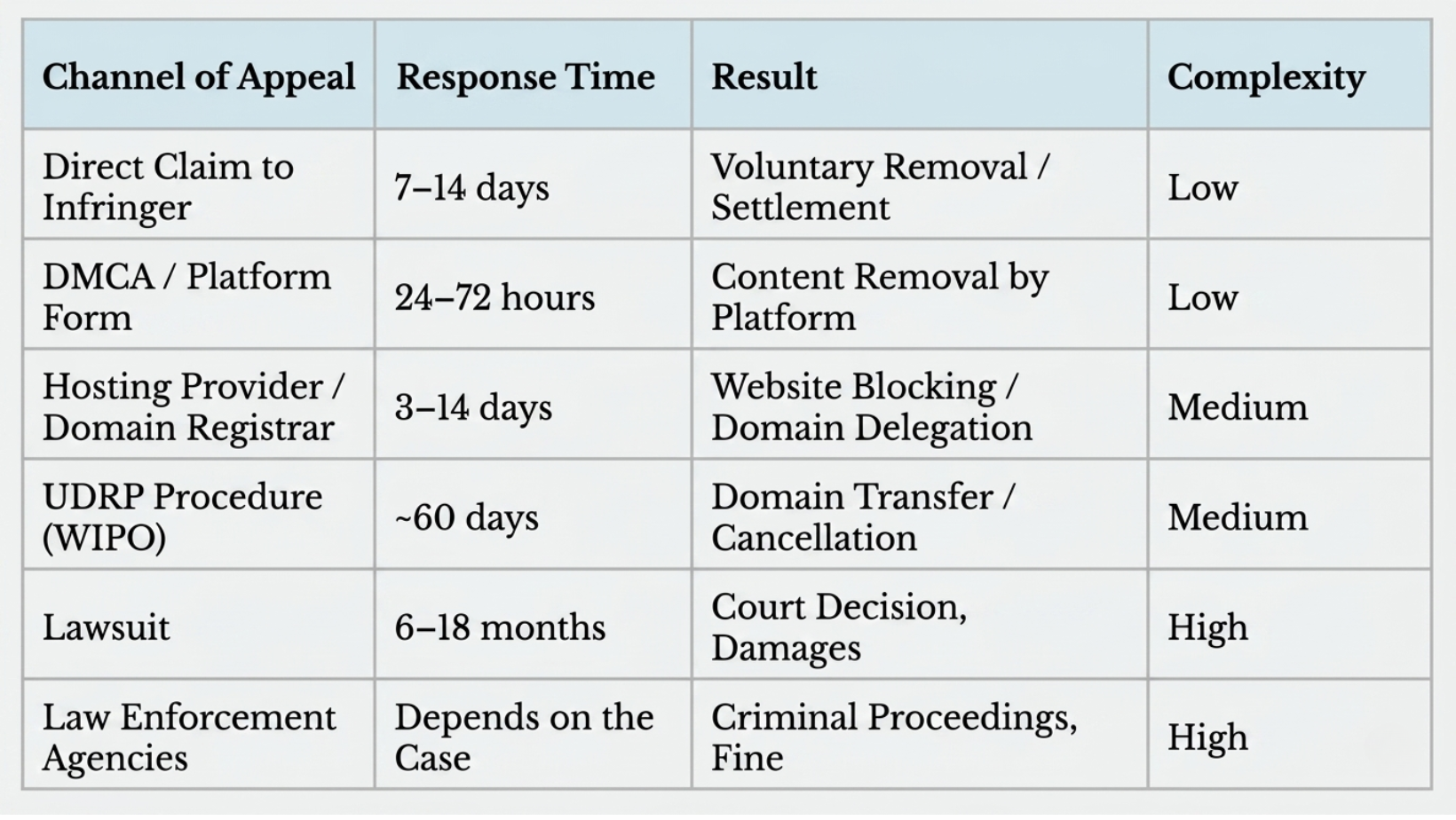
Comparison of communication channels
Step 3. How to Properly Draft a Notice?
A notice should include the following mandatory information:
- The full name or company name of the rights holder and their contact details (full residential or registered address, telephone number, and email address).
- A precise identification of the work, trademark, patent, or other intellectual property right being infringed. For example: “We have identified an infringement of rights protected under Trademark Certificate No. [number], relating to the trademark [name].”
- Documents confirming ownership of the rights and, where applicable, the authority of the representative acting on behalf of the rights holder.
- The specific location of the infringement, including the URL of the webpage or file containing the infringing content.
- A statement confirming that the information contained in the notice is accurate and that the use of the content has not been authorised by the rights holder or permitted by law.
- A clear and unambiguous demand to remove the content or restrict access to it. For example: “Disable access to the electronic (digital) information available at [link] in relation to the account ‘[name]’.”
Supporting Documents
It is recommended to attach the following documents to the notice:
- Evidence documenting the intellectual property infringement;
- Trademark Certificate;
- Industrial Design Certificate;
- Legal Services Agreement;
- Exclusive Distribution Agreement;
- Any other documents confirming ownership or enforcement rights.
Specific Features of a DMCA Takedown Notice
A DMCA Takedown Notice (a notice requesting removal of content under the United States Digital Millennium Copyright Act) has become the de facto global standard for platforms registered in the United States, including Google, Meta, YouTube, Amazon, and Cloudflare. Although the DMCA is based on U.S. law, its procedures are applied worldwide because most major technology companies operate under U.S. jurisdiction.
A properly drafted DMCA notice should include:
- Identification of the original copyrighted work or trademark;
- The exact URL or location of the infringing material;
- The claimant’s contact details;
- A statement of good-faith belief that the use is unauthorised;
- A declaration that the information provided is accurate, made under penalty of perjury;
- The signature of the rights holder or their authorised representative.
Platforms are generally required to respond promptly—typically within 24 to 72 hours—or risk losing the protections afforded by the Safe Harbor provisions.
It is important to note that if the alleged infringer believes the content was removed in error, they may submit a counter-notice. In such cases, the platform must notify the rights holder, who then has approximately 10–14 business days to initiate legal proceedings; otherwise, the content may be restored. Accordingly, the DMCA process is not a final determination of rights and may require judicial enforcement in more complex disputes.
Why Engage a Lawyer?
It is advisable to approach an infringer through a lawyer to ensure that the notice is properly drafted in accordance with applicable legal requirements, that the claims are clearly formulated, and that the relevant intellectual property rights are correctly identified.
A lawyer’s demand letter or formal legal notice often increases the likelihood of resolving the dispute without litigation. Professional legal representation demonstrates a willingness to pursue judicial remedies if necessary and encourages the other party to engage in constructive dialogue.
In addition, a lawyer can ensure the proper collection, preservation, and procedural presentation of evidence, which may prove crucial if the matter proceeds to court.
Step 4. Consequences of the Notice and Further Actions
If the Infringer Responds Positively
If the infringer responds positively and removes the disputed content, the matter is generally considered resolved, and the rights holder may confirm compliance with the requested actions. Entering into a settlement agreement allows the parties to formally record the absence of further claims, avoid litigation, and define the terms of any future cooperation.
Nevertheless, it is advisable to retain evidence confirming the removal of the content (for example, a dated screenshot), as this may prove useful if the same party commits a similar infringement in the future.
If the Infringer Does Not Respond or Continues the Infringement
If there is no response or the infringement continues, the following steps may be considered:
- Filing a complaint through the DMCA system (for U.S.-based platforms) or through equivalent platform-specific procedures;
- Contacting the hosting provider or domain administrator with a request to remove or block the infringing content;
- Initiating court proceedings and, where appropriate, filing a complaint with law enforcement authorities;
- Commencing a UDRP (Uniform Domain Name Dispute Resolution Policy) proceeding through the World Intellectual Property Organization (WIPO) in cases involving domain name disputes.
Liability of Internet Intermediaries: The Safe Harbor Principle
Enforcement against infringers is closely linked to the concept of intermediary liability, which concerns hosting providers, domain registrars, and platform operators. In most jurisdictions, including Ukraine under the Law of Ukraine “On Copyright and Related Rights,” the principle of intermediary neutrality applies. Under this principle, a hosting provider is generally not liable for intellectual property infringements committed by its users, provided that it promptly removes or disables access to the infringing content after receiving a properly submitted notice.
However, if a provider receives a valid notice and fails to act, it may be held liable as a party contributing to the infringement (contributory infringement). For this reason, most major providers and online platforms maintain dedicated complaint-handling procedures and appoint responsible officers, often referred to as Designated Copyright Agents.
Understanding this mechanism enables rights holders to exert pressure on two parties simultaneously: the direct infringer and the platform that facilitates the infringing activity.
A similar approach applies to online marketplaces. Platforms such as Amazon, OLX, and Rozetka may bear a higher level of responsibility than traditional hosting providers because they derive commercial benefit from the sale of goods through their services. As a result, their obligation to respond to infringement notices is often stricter, and failure to act after receiving a valid complaint may create greater legal exposure.
Conclusion
Effective protection of intellectual property rights on the internet requires the prompt identification of the infringer and immediate communication demanding that the unlawful activity cease. The key to success lies in a structured and sequential approach: proper evidence preservation → a legally sound notice → removal of the infringement through platform and provider complaint mechanisms → judicial enforcement as a measure of last resort.
Where pre-litigation efforts fail, judicial remedies become necessary. Internet intermediaries play a crucial role within this framework, and their liability is governed by the Safe Harbor principle. Under this regime, intermediaries are exempt from liability only if they respond promptly and appropriately to infringement notices. Consequently, a well-prepared notice addressed simultaneously to the infringer, the platform, and the hosting provider is often the most effective tool for restoring rights quickly without resorting to lengthy court proceedings.
This model strikes a balance between the interests of rights holders and the broader digital community. It provides rights holders with effective enforcement mechanisms while ensuring that platforms cannot avoid responsibility for infringements of which they knew, or reasonably should have known.
Share


FAQ
Як зафіксувати порушення прав інтелектуальної власності в інтернеті?
Що таке DMCA Takedown Notice і як його подати?
Що повинна містити претензія до порушника прав ІВ?
Чи обов'язково залучати адвоката для звернення до порушника?
Що робити, якщо порушник не реагує на претензію?
Що таке правило Safe Harbor і як воно захищає хостинг-провайдерів?
Чи можна вирішити спір про порушення прав інтелектуальної власності без суду?
Як зафіксувати порушення прав інтелектуальної власності в інтернеті?
Зробіть скріншоти сторінок із порушенням із зазначенням дати та URL. Збережіть копії файлів, відеозаписів або товарів (за потреби придбайте контрафакт як доказ). Для максимальної доказової сили зверніться до нотаріуса для засвідчення огляду веб-сторінки відповідно до статті 75 Закону «Про нотаріат». У разі значного порушення залучіть експертну установу. Ці докази знадобляться як для досудового звернення, так і для судового процесу.
Що таке DMCA Takedown Notice і як його подати?
DMCA Takedown Notice - офіційне повідомлення про порушення авторського права, яке зобов'язує платформи (YouTube, Meta, Google та ін.) видалити незаконний контент. Для подачі такої заяви потрібно вказати: свої контактні дані, опис оригінального твору, посилання на порушення, підтвердження прав та вимогу видалення. Більшість платформ обробляють заявки протягом 24–72 годин. Якщо порушник подає counter-notice, у правовласника є 10–14 робочих днів для звернення до суду.
Що повинна містити претензія до порушника прав ІВ?
Претензія має включати: повні контактні дані правовласника або його представника; опис об'єкта ІВ із реквізитами (номер свідоцтва ТМ, патенту тощо); посилання на конкретне місце порушення (URL); докази права власності; однозначну вимогу видалити або заблокувати контент; строк для реагування (зазвичай 7–14 днів). Рекомендується складати через адвоката.
Чи обов'язково залучати адвоката для звернення до порушника?
Не обов'язково, але але є доцільним заходом для захисту інтересів.. Звернення через адвоката демонструє серйозність намірів, забезпечує юридично коректне формулювання вимог і підвищує шанси на досудове врегулювання. Крім того, адвокат правильно ідентифікує об'єкт ІВ і забезпечує належне оформлення доказів, що є критичним у разі подальшого судового розгляду.
Що робити, якщо порушник не реагує на претензію?
Якщо порушник ігнорує звернення, наступні кроки: 1) подати скаргу через DMCA або форму платформи (YouTube, Meta, Google); 2) звернутися до хостинг-провайдера або адміністратора домену; 3) подати позов до господарського суду або звернутися до правоохоронних органів; 4) у випадку доменних спорів - ініціювати процедуру UDRP через Всесвітню організацію інтелектуальної власності (строк розгляду ~60 днів).
Що таке правило Safe Harbor і як воно захищає хостинг-провайдерів?
Safe Harbor (захисна гавань) - принцип, за яким хостинг-провайдер звільняється від відповідальності за порушення прав інтелектуальної власності його користувачами, якщо він оперативно видаляє контент, що порушує права, після отримання належно оформленого повідомлення. Якщо провайдер ігнорує повідомлення він може бути притягнутий до відповідальності як особа, що сприяє порушенню. Маркетплейси несуть підвищену відповідальність порівняно зі звичайними провайдерами.
Чи можна вирішити спір про порушення прав інтелектуальної власності без суду?
Так, у більшості випадків. Досудове врегулювання через пряме звернення до порушника, подачу DMCA notice або скаргу на платформу вирішує проблему швидше та дешевше, ніж судовий процес. Суд є крайнім заходом і застосовується, коли порушник ігнорує всі попередні звернення, завдані збитки є значними або необхідне стягнення компенсації.


We use cookies to improve the performance of the site and enhance your user experience.
More information can be found in our Privacy Notice